
The holiday season is coming up, eventually, and it’s never too late to start thinking about what to get that storyteller in your life.
I started with that cliche, but I’m not going to get to my list just yet. First I’d like to reflect on how this list is a beautiful example of my preferred style of capitalistic collection. Not all of the games in the list I bought myself, but someone did. In 2024, the global board game market was valued at an extreme 14.7 billion western moneys (at those values, it doesn’t really matter euros, pounds, or dollars). That’s a lot of moolah, and I definitely do my part to contribute to it every year. No one needs so many board games, most I haven’t even played in years. :(
I hope you learn from my mistakes, keep your collection lean! If you have board games around your house not being played, give them to a home that has time to love them. I’m starting my own journey of parting with underplayed games. It’s going to mean some hard choices, but in the end I will have a collection that gets more plays and takes up less space. Gifting a storytelling game to a friend is a chance for you to pass on not only chance for them to facilitate a great time with their friends, but also an opportunity for you to help grow their storytelling talents.
There’s another aspect of the board game market that does make me feel somewhat better about my purchasing practices. Most board game shops I’ve been to around the world are little mom-and-pop or three-friends-and-dream kind of shops. Places where spending money feels at least a little bit better than it usually does. If you find yourself inspired by this list, please go drop by your local game shop and ask them about storytelling games! You’ll already know a few, but I’m sure there are plenty of more great ones out there just waiting to be played.
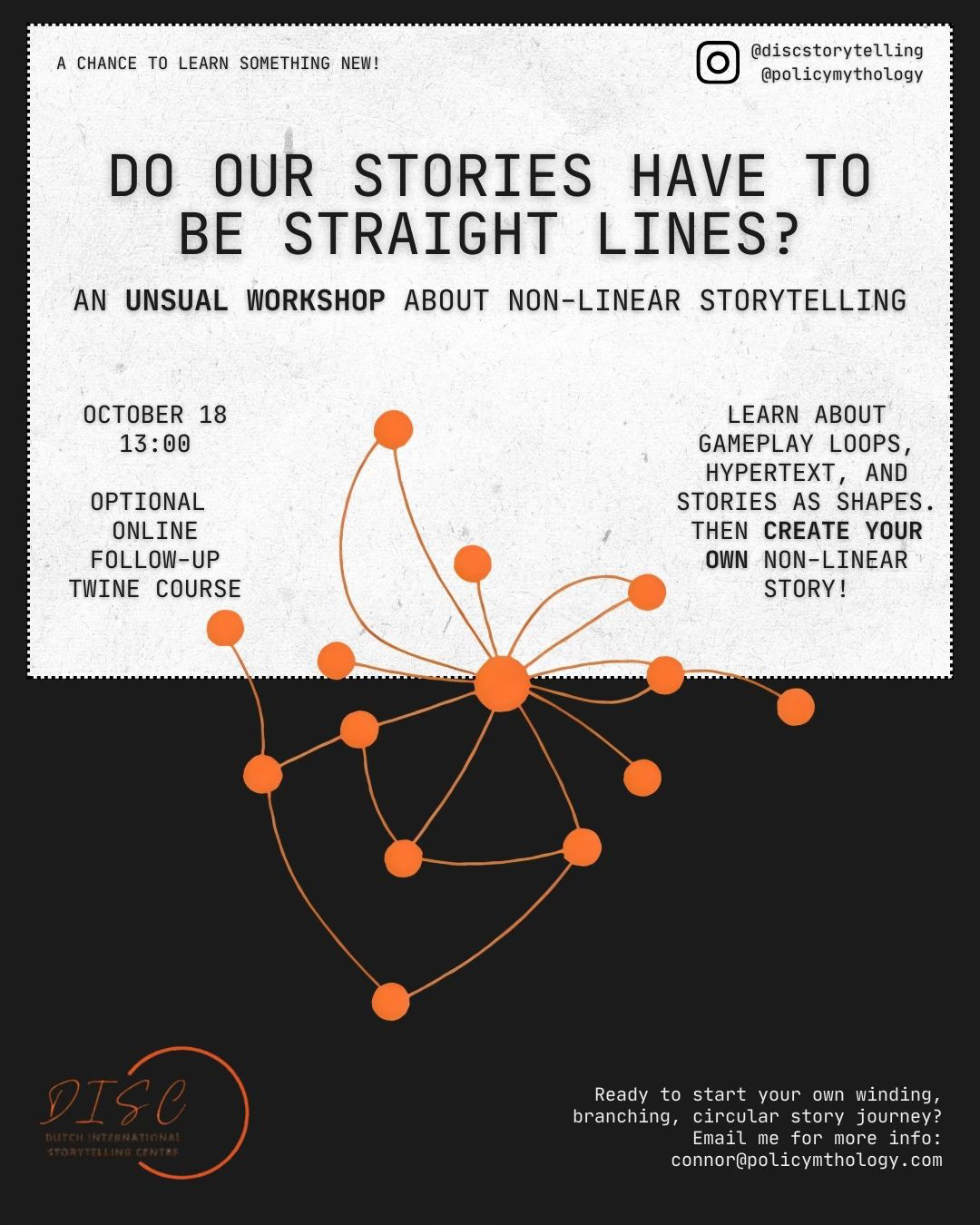
The real reason I’m working through my board game collection is far more practical. In October I am hosting a workshop on non-linear storytelling and I’m digging for the best examples I have on hand.
Onto the Reviews
So okay, for the last few years I’ve been spending perhaps too much money building up a collection of storytelling games. I love these games because I love collaborative and improvisational storytelling, and they are an easy way to make up stories with a bit of help from a system! These games are great ways to introduce friends to the world of storytelling and bring something new to the table with your storytelling friends. Storytelling games are also an excellent way to generate new story ideas for yourself, several of the stories I have shared on storytelling nights have come from gaming sessions, either intentionally or unintentionally. I have also used several of these games in live play sessions to co-create a story on the spot with the audience.
The games in this list range from simple, contemplative one-person storytelling games to epic collective storytelling adventures that can span weeks or months of real time. The cheapest in the list is nearly free, and the most expensive can easily top 150 western moneys for the base game and expansions. Many of the games in this list are available as “print-and-play” meaning you can buy digital copies to play from your screen or print and staple into your own booklets. I’ve marked these in the list with a ⓟ symbol, and many of them I just play from my iPad.
There’s another important aspect of these games to consider: does everyone at the table get to play? It might seem like a strange question, but it has a really important answer. In some games, especially role-playing ones, there is a game master (or dungeon master, conductor, etc.). This person is responsible for providing the flavour, context, and much of the characterisation of the world the players are exploring. Each player is usually responsible for the thoughts, actions, and words of a single character in the party, while in some games also offering input to the rest of the world as well. In the GM seat you are playing a totally different game than the rest of the table, simultaneously creating most of the action, while also trying to avoid becoming the centre of attention. These games I have marked with a ☃ symbol, cause I thought he was cute.
Thinking Storytelling Games
There’s a few ways I see storytelling happening in games. First there’s the obvious: games that invite you to make up the story directly: explicit storytelling. These can be role-playing, storytelling, or improv games to name a few. These games give you space to create the story in any way you see fit, within a given amount of structure. The higher the freedom, and the more that freedom melds with the gameplay, the higher the rating.
But there’s another way games let you tell stories: through their design and mechanics. In this situation you are not creating stories directly, but through your actions you are playing out part of the story the game lays out for you. We could think of this as implicit storytelling, you are not tasked with creating the story yourself, but through your actions you can bring a story to life from what the game provides you! This is all about mechanics, how the gameplay builds upon itself to create a narrative as you progress. The more a game’s rules create layers for a story, the higher the score.
There’s one more element of storytelling I want to add, and that’s world building. Some games give you super rich, complicated worlds to dive into. Others will give you nothing, or a bare minimum to start, either relying on the gameplay or the imagination to bring you through the night. There are a number of reasons why more is not always better in this category, but for the sake of simplicity, the richer the world that is provided, the higher the score.
The best storytelling platforms combine all three aspects of storytelling. They give space to people to unleash their own imagination, offer choices that build upon each other to create narratives as you go, and give detail to the story that helps it carry meaning. Higher ratings do not always lead to higher rankings, gameplay is not the same as storytelling potential. With many games there’s a sweet spot between all three that creates a wonderful storytelling environment.
The Known, But Unowned
Before we get to the list of my collection, there are two games I want to talk about, both of which are older than me (and any other game on this list)! They never really have inspired me to make the purchase, so I guess technically that sends them to the bottom of my list.
38. Dungeons and Dragons ☃
Explicit Storytelling ★★★★☆?
Implicit Storytelling ★★★★★?
World Building ★★★★☆?
Number of Players: 2+
The grandaddy of all role-play storytelling games, first published in 1975 and still being updated regularly and played around the world every day. There are dozens of channels on YouTube and Twitch dedicated to streaming gameplay sessions, and there’s even multiple seasons of an animated television show based on a story created during a gameplay session.
If you have a group of friends who are already playing, or can find a group willing to let you join, it’s definitely worth making the investment. If you have neither of those, keep reading, there are many more beginner-friendly TTRPGs in the list.
37. Tales of the Arabian Nights
Explicit Storytelling ★☆☆☆☆
Implicit Storytelling ★☆☆☆☆
World Building ★★★☆☆
Number of Players: 2-6
This game is just too much reading! I’ve had it recommended many times over and so when I finally played it, I was sorely disappointed. It’s seemingly random, and while some of the stories contain interesting twists, many of the others fall flat. There’s a few games similar to this in much closer to the top (or actually bottom) of my list that I think make for much more engaging storytelling.
Ubiquitous, If Somewhat Useless as a Game
These things are everywhere.
36. Rory’s Dice
Explicit Storytelling ★★★★☆
Implicit Storytelling ☆☆☆☆☆
World Building ★☆☆☆☆
Number of Players: Many Variations
I have so many sets of these themed dice with an icon on each side, I bought a special case just to put them all in. People tend to buy them for storytellers, they seem like such a good idea, but I’ve never really gotten them to work purely for fun. Which is disappointing because they have this great look and feel. They are handy for some types of brainstorming and ideation, especially in workshops with students, but as far as a game in themselves they leave lots to be desired.
The Purchased, but Unplayed, and Therefore Ranked*
35. Untold Adventures Await
Explicit Storytelling ★★★★☆?
Implicit Storytelling ★★★★★?
World Building ★★☆☆☆?
Number of Players: 1-4 Players
That disappointment in those may be resolved in Untold Adventures Await turns out to be a good game! It is designed for use with Rory’s Story Cubes, which is why I originally bought it. It’s set up like you are making a movie, using cards and the dice to build your story collectively as you go.
It gets a preemptive knock because it requires extra purchases to get the most out of it, the dice are not cheap.
34. Stories of the Three Coins
Explicit Storytelling ★★★★☆?
Implicit Storytelling ★☆☆☆☆?
World Building ☆☆☆☆☆?
Number of Players: 2-5
This is one I’m really skeptical about. Not only because the box looks so much like a book, I sometimes forget it isn’t one. There’s just something about the quality and the setup I just don’t get the best gameplay vibes from. I hope it proves me wrong, but perhaps my pre-play judgement will keep it from my table forever?
33. Shades of Ink
Explicit Storytelling ★★★★☆?
Implicit Storytelling ★★☆☆☆?
World Building ★☆☆☆☆?
Number of Players: 1
This ink-blot inspired solo storytelling journey invites you to interpret a set of encounters with Shades, magical creations set on stopping you from continuing your journey. This game seems to allow for lots of space questions about the nature and motivations of the Shades, and suggests that the more richly you answer them, the more satisfying the ending will be.
32. The Family Dinner
Explicit Storytelling ★★★★☆?
Implicit Storytelling ★★☆☆☆?
World Building ★★★☆☆?
Number of Players: 2-6
You and your fellow players work together to create a family tree, and then keep adding to it as new family members keep appearing around the dinner table over the course of a meal. Each card in this game contains an ingredient and two different possible storytelling scenarios, which feels like a nice balance between openness and choice. This one seems really fun! I’ve thrown it in my bag many times for board game night, but haven’t been lucky enough to get it to the table.
31. It’s Kind of a Funny Story
Explicit Storytelling ★★★★☆?
Implicit Storytelling ★☆☆☆☆?
World Building ☆☆☆☆☆?
Number of Players: 3-10
This looks nice, and the box is bigger than most prompt-on-card games, so I am hopeful. I have the grown-up version, and gave the family version to my brother so he could play it with his kids, but they’re not quite old enough to play. I’ll let you know whose table this gets to first.
30. Grok ☃ ⓟ
Explicit Storytelling ★★★★★?
Implicit Storytelling ★★★★★?
World Building ★★★★★?
Number of Players: 2+
Well this one sure looks like a trip! The art is just wild, world-building inventiveness, and the gameplay looks like it has some nice twists on the role-playing genre.
29. The Station ⓟ
Explicit Storytelling ★★★★★?
Implicit Storytelling ★★★★★?
World Building ★★★★★?
Number of Players: 2-6
Definitely number one on my to-play list, it promises to be “a game about the impacts of places and people on each other.” You play as a group of people gathering a train station, waiting for the first train to arrive in a very long time. A fairly new game whose rulebook even has an adaptation for online play!
Not Really Scratching That Storytelling Itch
These touch on storytelling in some way, but it’s not really at the core of what they do. Still, they sometimes make for fun stories!
28. Dixit
Explicit Storytelling ★★☆☆☆
Implicit Storytelling ★★☆☆☆
World Building ★☆☆☆☆
Number of Players: 3-8
With more than half a dozen versions, Dixit has proven itself as a rich and beautiful game to tell fun tiny stories. Somehow I played this game more when i did not own it…
27. Space Cats Fight Fascism
Explicit Storytelling ☆☆☆☆☆
Implicit Storytelling ★★☆☆☆
World Building ★★☆☆☆
Number of Players: 2-4
This is an honourable mention for a game that tells a really powerful story. There’s not really much of any room for explicit, or even implicit storytelling in the game itself. It’s pretty clearly a game about points and moves. The cats in outer space provide a really silly veneer for a really serious topic.
But the story these mechanics create through the course of the game is so powerful! The game shows simply and clearly that the fight against facism is endless, constant, and at times overwhelming. Each time we finish playing we have a beautiful conversation about what this game has told us about our own world.
26. Near and Far
Explicit Storytelling ★☆☆☆☆
Implicit Storytelling ★★★★☆
World Building ★★★★☆
Number of Players: 2-4
No game frustrates me more than this beautiful masterpiece. The art is amazing. The concept and the world are beautiful. The mechanisms are fun, if a bit clunky. But the game is just too big, with too many pieces, moving parts, and chunky obtuse strung-out story that just makes it hard to dive in and go for. If you have a group of 3-4 people who can stick out the slow bits and long set up time, you’re going to have an amazing adventure! But if you’re like me, it’s going to get passed over time and time again for simple games that give more time for play and less time for setup.
25. Arcs
Explicit Storytelling ☆☆☆☆☆
Implicit Storytelling ★★★★☆
World Building ★★★★☆
Number of Players: 2-4
This is probably the newest game on my list, and also probably the highest ranked on the board game website Board Game Geek. It’s definitely the most complex, and probably the hardest to master as well. With a bevy of the different civilisations, guilds, leaders, and setups, Arcs offers a rich storytelling palette atop a grand space opera. Not always, but sometimes, it uses this to create rich, heart breaking stories. I will forever remember the game my plucky band of scattered rebels could never out spend or out fight the economic empire armed with their advanced ship-seeking missiles. By the end of the game the story felt so true, I was destined to lose.
The art and world building are such a great part of this game, there’s so much potential for injecting personality in this game’s galaxy. It’s heavy though, both literally (the box has a heft to it) and metaphorically as in it's not easy to get the hang of until you play a few times.
Story Generating Decks
There are so many of these out in the world now, it’s hard to go wrong, but also hard to get it totally right. They all have questions or prompts on cards, and you take turns telling stories. They mostly differ in the types of prompts for you to tell from.
24. Float Downstream
Explicit Storytelling ★★☆☆☆
Implicit Storytelling ★★☆☆☆
World Building ★☆☆☆☆
Number of Players: 1
This reflective one player game develops like an introspective poem in its best moments, even if sometimes it feels like they take a bit of coaxing. Not exactly a deck of prompt cards, but not different enough to garner its own category.
23. The Moth Presents: A Game of Storytelling
Explicit Storytelling ★★☆☆☆
Implicit Storytelling ★★☆☆☆
World Building ★☆☆☆☆
Number of Players: 4+
Inspired by The Moth, a New York based storytelling group that long ago went global. This deck includes both themes and prompts, which adds a lot of variety and spark to the stories. The tradeoff is that means they tend to be bigger and more complicated stories, which makes it tougher for new players or shy storytellers.
22. 52 Questions
Explicit Storytelling ★★☆☆☆
Implicit Storytelling ★★☆☆☆
World Building ☆☆☆☆☆
Number of Players: Many
This is probably pretty much like any other deck of prompt-cards you can find. It’s a pretty good set of story-generating ideas and questions. Not the most exciting game, but one I bring out if there’s a group who wants to get to know each other better.
21. Campfire Stories Deck for Kids
Explicit Storytelling ★★☆☆☆
Implicit Storytelling ★★☆☆☆
World Building ★☆☆☆☆
Number of Players: Many
I know it says for kids, but I’m a kid at heart. This is currently my favourite deck of prompts because it’s light and the cards are big and sturdy so I have no fears about bringing them to storytelling nights for us to play with.
Serious Games
These are games you don’t really play for fun. They are more well suited to something like family time, or with colleagues. They are also story-generating decks but I have put them in their own category because they both have a bit more structure and have a specific sense-making purpose.
20. Narratopia
Explicit Storytelling ★★★★★
Implicit Storytelling ★★☆☆☆
World Building ☆☆☆☆☆
Number of Players: Many
I have played several versions of Cynthia Kurtz’s game during my time with the WE Program. I like how it is flexible, you can adapt it to the needs and space you have to explore a project or program you are working on. It always reveals layers of stories for me, something about her questions helps us dig deeper than we imagine we could go.
19. Listen For
Explicit Storytelling ★★★★★
Implicit Storytelling ★★☆☆☆
World Building ☆☆☆☆☆
Number of Players: Many
Where Narratopia goes down, Listen For goes outwards! In this game you are each asked to listen for different elements of a story and share what you heard. Listen For can be used to create really beautiful, intimate moments of sharing and always gives me new insights into my own stories. I really love how the PercoLab team uses their principles to give new perspectives to our own stories!
Storytelling with Pictures
Instead of prompts, these games give you pictures to tell your stories from. These are really flexible games that can be adapt to a lot of different situations.
18. Story Puzzle (from Flying Tiger)
Explicit Storytelling ★★☆☆☆
Implicit Storytelling ★★☆☆☆
World Building ★☆☆☆☆
Number of Players: Many
Actually, this is a surprisingly cool game. The puzzle stretches out in a long wavy line, and pieces can fit on either end, letting you add to the front or the back of the story. The story is a bit basic, but it’s a cool concept and is good for telling stories with young kids. I sometimes use this when I tell stories at schools, giant puzzle pieces help the kindergarteners focus.
17. eeBoo Create a Story Cards
Explicit Storytelling ★★☆☆☆
Implicit Storytelling ★★☆☆☆
World Building ★☆☆☆☆
Number of Players: Many
These big cards have beautiful drawings to help you create stories. There are many settings to choose from, mine is sort of modern day woodland paradise, with anthropomorphic animals living out daily lives. The structure of the game is pretty light, so a lot of times I just use the cards and make up my own rules. The rich detailed images give lots of things for shy storytellers to hold onto as they get comfortable with telling stories in a game.
16. Windmill: Cozy Stories
Explicit Storytelling ★★☆☆☆
Implicit Storytelling ★★☆☆☆
World Building ★☆☆☆☆
Number of Players: 3-5
This game has a really cool setup I just haven’t been able to convert into a compelling game yet. Much like the more well known Dixit, Windmill Stories asks you to create a small story from a card without revealing exactly which card you are telling from. Make it too easy, or too hard, and you don’t get any points.
The setup of this game is really cool, you lay out a whole grid of these beautiful story cards. I find that usually it’s too much, and once it’s my turn to focus on telling the story from one card, I can only see all of the stories from the other cards.
15. The Shadow World
Explicit Storytelling ★★★☆☆
Implicit Storytelling ★☆☆☆☆
World Building ★★★★☆
Number of Players: Many
Shadow world works much the same way as the Story Puzzle, but the book comes with several different variations that make for interesting changes of place when you play. There are several similar games that appear to be by the same publisher, though I have only ever seen this game on sites like Amazon and independent bookshops that likely bought it from the same distributor. Really beautiful art and interesting design for this type of game, definitely worth picking up in person to support your local if you get the chance.
A Big Group Game, A Classic, and A Storytelling Game Made of Plastic
Three games that couldn’t quite crack the top-ten. Each offers something different and are all good additions to a collection.
14. The Awkward Storyteller
Explicit Storytelling ★★☆☆☆
Implicit Storytelling ★★☆☆☆
World Building ★☆☆☆☆
Number of Players: 4-11
A funny and quite random game that asks you to tell awkward stories using prompts and words it gives you. The other players vote on the believability of your story. What I really like about this game is its ability to handle big player counts, it’s listed from 5-12, which you don’t often find in storytelling games.
13. Once Upon a Time
Explicit Storytelling ★★★★☆
Implicit Storytelling ★★★★☆
World Building ★★★★☆
Number of Players: 2-6
The oldest storytelling game in my collection, first published in 1993 and still a beautiful addition to any shelf. This is one of those games that goes much better with house rules in place. It starts by giving you ending cards, and tries to set you up to use one of them after a whole bunch of other story cards get played. But it’s often hard to contrive your story to match the ending like they want you to, so we usually change how the ending cards are used to make the game more pliable. It comes with a scoring system, but I usually scrap that too and just play for the sake of the story.
So with all those problems, why is it so high in the rankings? Well the art has aged really well, it still has a lot of beautiful things to look at on the cards. These cards hold all of the elements of classic fairy tales, but the game structure lets up go wild with the storytelling. I vaguely remember a game we once played where a prince married a horse! We’ve also had plenty of big, splashy impactful endings to stories where everything comes together at just the right moment.
There’s also a companion book that you can buy for this game that is supposed to help you write stories using the cards. I own it but have yet to do more than skim the book. Still, a pretty neat idea.
12. Gloom
Explicit Storytelling ★★☆☆☆
Implicit Storytelling ★★★★☆
World Building ★★★★★
Number of Players: 2-5
For some, this may be a surprising entry on this high list. I’m pleasantly surprised myself. On the surface, it’s not much of a storytelling game. The game itself is built atop a true novelty, see-through cards that you stack up as you play. But the world building and the mechanics align much like those stacked cards do, to so often create great moments of storytelling. In a game where bad things are worth points, the time a member of my house fell in love with a member of another house, got married, and gave them flowers on the wedding day was both a great story and a huge swing in the points. Every time we play Gloom a ridiculous comic-tragic story emerges.
This definitely gets knocked a bit because of the plastic cards, not only are they bad for the planet, they can be a bit tricky to play with. Still, a really cool concept and excellent execution.
My Other Favourite Table Top Role Playing Games
There’s so many role-playing games out there, in general, these are games that give you control over one character and drop them into a world co-created with other player-characters, where you then act out some sort of (often wild) adventure. A hallmark of most of these types of games is the role the Game Master plays in creating the setting and driving the story forward.
11. Adventures on a Dime☃ⓟ
Explicit Storytelling ★★★★★
Implicit Storytelling ★★★★★
World Building ★★★★★
Number of Players: 2+
I really like this TTRPG because it’s not grounded in violence like many of the other games in this genre. Instead of being rigid pre-defined roles, players in this game are invited to create their own unique skills and capabilities for their characters. This means that each game feels very unique!
The setting of this game is heavily influenced by stories like Redwall Abbey and Watership Down. I love this motif, and enjoy the creativity that comes with players filling the shoes of non-human characters. This is an excellent game for newcomers and veterans alike.
10. Adorablins ☃
Explicit Storytelling ★★★★★
Implicit Storytelling ★★★★★
World Building ★★★★★
Number of Players: 2-5
It’s right in the name, this game is frickin’ adorable! Just looking at the tiny tin, the goblins, and that moustachioed mushroom on the cover make me smile. This game has a shorter player time and lower age requirement than most role-playing games, which makes it really good for a storytelling family. You play as a group of goblins forced to delve into the strange and giant world of humans to retrieve a lost mcguffin. A great game for inventive, silly storytelling.
9. I Guess This is It
Explicit Storytelling ★★★★☆
Implicit Storytelling ★★★☆☆
World Building ★★★★☆
Number of Players: 2
An intimate game about saying goodbye, and if you play it right, it might make you cry. This two player game helps you tell the story of a parting, as you both try to resolve loose threads before time runs out and things are left unsaid.
A very simple game with only 18 cards, like every game from the publisher Button Shy, but that’s enough to drive your story to places you might never expect.
8. Honey Heist ☃ ⓟ
Explicit Storytelling ★★★★★
Implicit Storytelling ★★★★★
World Building ★★★★★
Number of Players: 2+
There is no game I have played that has ever been as funny as my first session of Honey Heist. This super simple role playing game puts you in the paws of bears looking to get back their honey. Hilarity soon ensues as the bears try to refrain from their animal instincts along the way as the players act out a heist movie. The storytelling, mechanisms and world building blend for an excellent session of storytelling every time. It’s also very simple to teach to new players, which is a huge bonus. The whole game fits on one piece of paper!
Three Personal Favourites
These games all hold special places in my collection, these are the games that make it to the table most often.
7. Freelancers
Explicit Storytelling ★★★☆☆
Implicit Storytelling ★★★★★
World Building ★★★★★
Number of Players: 2-5
This game literally tells you a story with the assistance of an app! There is tons of excellent voice acting narration that guides you through a detailed world of fantasy and wonder. The game also distributes the roles typically assigned to a game master between the app and all of the players, so it has a collaborative feel and everyone gets to play as a character.
While the game excels at telling you a story, sometimes this really limits your ability to be extra creative. Still it is loads of fun and a great stepping stone for players interested in role-playing games but not sure if they’re ready to take the plunge just yet.
5 & 6. The Artefact & Bucket of Bolts ⓟ
Explicit Storytelling ★★★★★
Implicit Storytelling ★★★★★
World Building ★★★★★
Number of Players: 1
Both of these one-page zine games are from designer Jack Harrison, and both invite you to tell a different kind of story. Imagine in Artefact you are telling the story of the One Ring instead of Frodo, or in Bucket of Bolts the story of the Millennium Falcon instead of Han Solo.
These games have an element I love that I think really enhances their storytelling power, they invite you to pause for moments of silence that get longer as the game progresses. They are intended to be one-player games but I have also enjoyed playing with friends. I have also used these in classrooms to help guide collaborative storytelling sessions with grade school students. I was lucky enough to score some beautiful paper copies, but the print-and-play
This builds tension and gives your mind to find more creative ways to continue the story. Personally I favour the sci-fi setting Bucket of Bolts offers.
4. Dungeon World ☃ⓟ
Explicit Storytelling ★★★★★
Implicit Storytelling ★★★★★
World Building ★★★★★
Number of Players: 2+
I must admit, I have never actually played this game. I have been the Dungeon Master for more than 50 sessions though, racking up hundreds of hours as the conductor to a four, five, or six person collective storytelling adventure. Dungeon World is very similar to Dungeons and Dragons in many ways, but there are few key differences.
Dungeon World is by design a bit more driven by storytelling and creativity, there’s a lot of flexibility for players to just make stuff! Then of course you have to roll the dice and see if it works. Speaking of dice, Dungeon World uses a slightly different system than Dungeons and Dragons. Without going into the math, this means that in Dungeon World things are more likely to get complicated!
This was my first foray into TTRPGs, and was a life-saver during lockdown. Right now it’s really high on this list for nostalgia, and I could imagine once I play Grok or another newer role-playing game, this will slide back with the rest.
A Category All Their Own
Three top-tier storytelling games that centre social issues. Come for the game, stay for the meaningful stories. I may not play these games most often, but they always result in memorable plays.
3. Solar Punk Futures ⓟ
Explicit Storytelling ★★★★☆
Implicit Storytelling ★★★★☆
World Building ★★★☆☆
Number of Players: 1-8
This is the type of game that could change the world. I love the mad-libs approach to a better future, every time I play this game we have super interesting conversations as we play and after we finish.
This is also a game I have played with a whole bunch of different types of people, even those I would never approach to play any other game. It’s just that important and that different. Download it now and take a look for yourself!
2. Lordsworn ⓟ
Explicit Storytelling ★★★★★
Implicit Storytelling ★★★★★
World Building ★★★★★
Number of Players: 2+
This is not a game to pick up and play lightly. Lordsworn delves into the world of trauma, heartbreak, and loss in a powerful way. Instead of the typical role-playing-system that has each player guiding one character, you collectively control the actions of a company of survivors struggling to make it home.
Spoiler alert, most will not. Watching your company wither away one-by-one as you try to navigate a world of impossible choices is a great gameplay experience.
1. The Quiet Year ⓟ
Explicit Storytelling ★★★★★
Implicit Storytelling ★★★★★
World Building ★★☆☆☆
Number of Players: 2-4
Avery Alder really hit it out of the park with this one! The first time I played this game to the finish, we all sat back and admired our work. We’d recruited, trained, outfitted, and drilled our army into peak condition. Meanwhile, a pile of trash blighting our community was untouched for the entire game. We looked around for the threat our army was to face, expecting to see the game guiding up to a climatic showdown. There wasn’t one. Nothing in the game told us to wrap so much of our story around the army, it was all us. That moment of reflection totally changed the story for us.
In The Quiet Year, there’s naturally lots of quiet. Each player is limited to only adding one sentence at a time to the story, but they can play from any perspective in the community. As you play, you collectively draw a map of your community and tell your story together.
Every time I play this game it surprises me with its clever use of playing cards and the complexity it injects into the game with the simple but deep questions it provides.
A Quick Reflection
I didn’t mean to make seven of the top ten print-and-play games, that was totally organic! But I do think there’s something to learn from it: storytelling games are hard to make, and perhaps even harder to sell in big volumes.
This gap has allowed designers like Avery Alder, Jack Harrison, and the team at Solarpunk Surf Club to bring impactful storytelling to the world of board games. There’s a lot of fun to be had on this list, but there’s also something else going on too. The power of storytelling once again has reminded us that we are only a small part of the one big story that is our world, and there are some beautiful storytelling games out there that use their stories to help us experience that from a new perspective.
I’m Connor the Story Engineer. I create games, experiences, and processes that help people and organizations share and make sense of the stories that matter to them. If you are interested in learning more about what these games can teach us about storytelling, message me for me information about my upcoming unusual workshop and learning lab about non-linear storytelling.
Special thanks to my friend Nia for inspiring me to finally write this article, and to Paulina for helping me edit this piece.